The Creator Dashboard
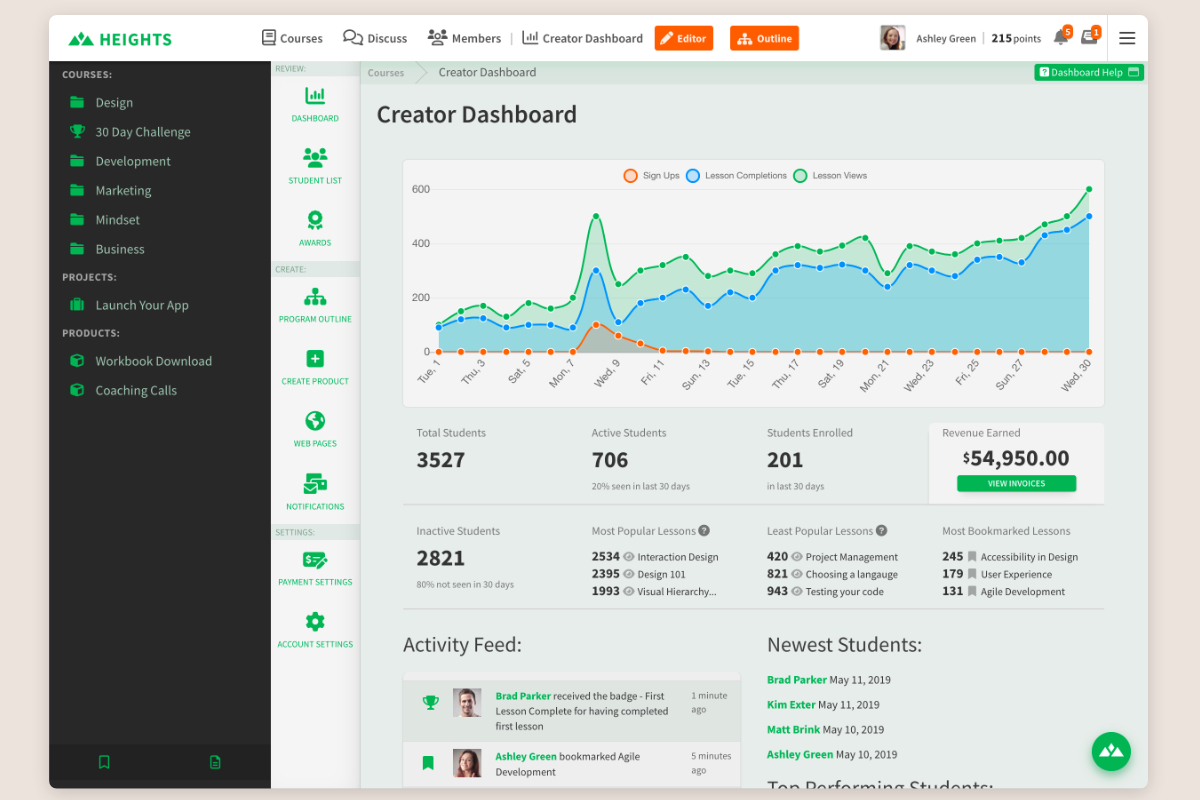
As a creator, whenever you log in to your platform, you will arrive at your Creator Dashboard. Here you can get an overview of the pulse of your program and students' progress as well as dig deeper into student analytics should you choose. This view also provides links to all areas of the program that you will need to adjust and is not available to any of your students.
Creating course lessons from your teaching documents
In the Product Generator, you can optionally upload up to five teaching documents, each no larger than 25 MiB. Word documents, presentations, spreadsheets, OpenDocument files, RTF, EPUB, CSV, plain text and text-based PDFs are supported. Uploads are private. Images and scanned PDFs cannot be read, and encrypted or damaged documents may fail conversion. If a document cannot be read, the generator explains the problem rather than writing replacement content.
Under Turn your knowledge sources into lessons (optional), click Choose Files to select several documents at once. Hover over or focus the question-mark icon for file limits and supported formats. Each file has a status badge; wait until all show a checkmark and Ready before generating your outline. Remove files with the remove button beside each one. Removing the last file automatically returns the generator to outline-only mode for your next generation.
When you start an outline from documents, the upload controls collapse to save space. Use Show knowledge sources to expand them again. A spinner and changing messages remain visible while your outline is being prepared; large documents can take several minutes. These messages are reassurance, not a percentage-complete indicator. The loading line disappears when the outline is ready, and errors reopen the source controls so you can try again.
With documents, the outline organizes your own method, terminology, examples and teaching progression. Review and edit that outline before selecting Save Created Products. Lesson writing starts only after saving, and only if your material supports the final outline and roughly 20 minutes of meaningful learning. Actual practice from your material can count; a long document, repeated sales promises or a list of topics alone is not enough.
The Recommendations tab gives feedback on the offer result you entered, whether or not you upload documents. With documents, it appears before Course Outline, so you can review that feedback while the outline is being prepared. If branding setup is needed, that step still comes first. Without documents, the original outline-first order is unchanged.
After saving, Heights AI also looks for an Unsplash course cover, as it does for courses created without documents. If no suitable image is returned, you can choose your own cover in the course editor. Existing covers are not replaced by a lesson-generation retry.
Without documents, the generator continues to create an outline and empty lessons. If uploaded material is insufficient, you can still save the outline and empty lessons, and the generator explains what teaching material is missing. An assessment error is shown separately and does not authorize lesson writing. Editing the outline requires a fresh assessment before lesson writing can proceed.
An AI processing error is different from an unreadable document or insufficient teaching material. The message identifies which step failed and whether to retry or contact support. If the problem continues, include the reference shown in the error when contacting support. Your documents are not replaced with generic lesson content.
While Heights AI checks your material and prepares your lessons, the course and lesson editors show a generation message instead of editing controls. Allow at least a few minutes; you can keep working elsewhere and return later. Choose Email me when ready to receive a completion email; Email notification on confirms your choice. Editing becomes available again when generation finishes, is skipped, fails or is interrupted. Completion emails are sent only after all lesson bodies have been successfully saved—not for skipped or incomplete generation.
If generation is interrupted, choose Retry lesson generation to start again on the same saved outline. A retry reassesses the current outline and does not create duplicate modules or lessons. It will not replace existing lesson text. Working documents are temporary; if they have expired or are insufficient, use Replace expired or insufficient documents in the course panel to upload a new selection before retrying. You can also keep the saved outline and write the lessons yourself. Review generated lessons before publishing.
Opening Heights AI 3 and using voice input
Heights AI 3 is available to creators on all accounts. Look for the Ask Heights AI… bar at the bottom center of your screen. Click the logo or message area to open the chat panel and start typing. The bar moves out of the way while chat is open and returns when you close it.
To speak instead of typing, click the microphone on the bar and allow microphone access if your browser asks. Chat stays closed while you record, and a waveform appears directly in the bar. Click the microphone again to stop. After transcription finishes, chat opens with your words in the message field. Review or edit the text, then send it from the chat panel; recording does not send a message automatically.
If microphone access is denied or transcription fails, the bar shows an error so you can try again or open chat to type. Leaving the page cancels an unfinished recording. In the web page editor, use the AI panel inside the editor instead of the floating bar.
Getting help from Heights AI and the support team
When Heights AI searches knowledge several times in a row, the chat combines those searches into one activity row. From the second search, a spinner appears until AI moves on to another activity or response. The row then shows a book icon and a summary such as Searched knowledge 3 times.
Hover over a completed AI response to give it a thumbs up or thumbs down. The buttons are also available by keyboard and on touch screens. A thank-you message confirms your feedback was submitted, and your rating remains visible when you reopen the conversation. If submission fails, you can try again.
At the top of the Heights AI chat panel, choose Knowledge Base to open our help articles in a new tab. Your current page and AI chat stay available while you read.
Choose Email Support to close the AI panel and open the support widget. Support contact buttons on the dashboard and billing pages also toggle this widget open or closed. The knowledge base is separate from the support widget.
If the support widget cannot open, you can email support@heightsplatform.com directly.
Understanding your dashboard statistics
The statistics below the activity graph summarize your students, contacts, community, and revenue. On wider screens, the first row shows Students enrolled, Contacts added, and Community posts. The second row shows Total students, Community cohorts, and Revenue earned. These summaries use a rolling 30-day period where indicated; revenue earned shows your lifetime total.
- Students enrolled counts students who created their account in the last 30 days and are now enrolled. This can include free enrollment; it is not a count of paid orders.
- Contacts added counts contact records created in your account in the last 30 days, whether or not they are linked to a student.
- Community posts shows the number of posts and replies made in the last 30 days by all community members, including creators and team members. If your community is turned off, the dashboard says so rather than showing an activity count.
- Total students includes student accounts that have not yet enrolled, but excludes creators and team members. Growth compares the current total with the total before the last 30 days.
- Revenue earned shows lifetime revenue and revenue in the last 30 days, with a link to your orders. It is only visible to creators with permission to view orders and revenue.
The older Active Students, Most Popular Lessons, and Most Bookmarked Lessons widgets have been replaced by community and engagement information.
Community cohorts and student engagement
The Community cohorts bar groups your enrolled students by their recent activity, including students enrolled for free. Creators, team members, and students who are not enrolled are excluded. This means posts made only by creators or team members can increase the Community posts count without moving any students into Warm or Engaged.
- Cold: neither of the activity criteria below is met. New students start in this group until their activity is assessed.
- Warm: a community visit in the last 30 days or a weekly engagement score of 1–4, unless the student qualifies as Engaged.
- Engaged: a community post, reply, or reaction in the last 30 days, or a weekly engagement score of 5 or more.
Hover over or focus the question-mark icon beside Community cohorts for these definitions. Counts appear beside each group, so you do not need to rely on the chart colors. Cohort refreshes are scheduled weekly on Sunday, not immediately after every action. Recent activity may not appear in a student's group until the next refresh completes. If no students have enrolled yet, you will see an empty-state message instead of a chart.
Newest students lists your five newest enrolled students by account creation date. Top performing students lists up to five enrolled students ranked by lifetime engagement, with both weekly and lifetime scores. Engagement considers lesson views, lesson completions, community participation when enabled, and sign-ins—not just the percentage of a course completed. Scores update periodically, and clicking a student’s name opens their profile.
Watch an introduction on how to create with Heights:
Popular Links Accessible from the Creator Dashboard:
Other Popular Articles:
Selling Enrollment Membership Versus Selling Individual Courses
Granting and Revoking a Learner's Content Access